Technology is no longer a back-office function. For most organizations, it is woven into every part of how the business operates — how teams communicate, how clients are served, how data is protected, how decisions get made. That means the quality of the partner managing that technology has a direct and measurable impact on the business itself.
Yet most organizations spend more time evaluating office furniture vendors than they do evaluating their managed service provider. They sign contracts based on price comparisons and response time commitments without asking the questions that actually determine whether the relationship will deliver what the business needs.
This is worth fixing.
The Difference Between Support and Strategy — and Why It Matters
The most important distinction in any MSP relationship is not about technology. It is about orientation.
Support is reactive. A system fails, a ticket opens, someone responds. The problem gets resolved and the cycle repeats. For many businesses, this is the entirety of what managed IT looks like — a help desk they call when something breaks. It is not nothing. But it is also a long way from what the best partnerships deliver.
Strategy is forward-looking. It starts with a genuine understanding of where the business is going — growth plans, operational changes, new hires, evolving client demands — and works backward to define what the technology environment needs to look like to support that trajectory. It identifies risks before they become incidents. It plans for capacity before demand creates strain. It makes technology decisions in the context of business outcomes rather than in isolation.
The businesses that get the most value from their IT investments are almost always the ones with a strategic MSP relationship. Not because strategy is more expensive than support — it does not have to be — but because it changes what the relationship is for.
If your MSP conversations are mostly about open tickets and renewal pricing, the relationship may be operating well below its potential.
The Real Cost of Reactive IT Management

Unplanned downtime costs money in ways that are easy to underestimate — lost productivity, missed client commitments, recovery time that pulls people away from the work that actually moves the business forward. Security incidents that could have been prevented with proper monitoring and patching consume organizational attention, create legal and regulatory exposure, and damage client trust in ways that are difficult to quantify and harder to recover from. Systems that fail at critical moments because deferred maintenance was never addressed create the kind of operational disruption that reactive models are almost designed to produce.
Proactive management addresses these costs at the source. Continuous monitoring catches anomalies before they become failures. Planned maintenance prevents the incidents that reactive models wait to respond to. Security is managed as an ongoing discipline rather than addressed in the aftermath of a breach. And the entire relationship is oriented around reducing the frequency and impact of problems — not maximizing response volume.
This is also a business model question, not just an operational one. Managed service providers that operate on recurring revenue models — fixed monthly fees for a defined scope of services — are structurally incentivized to keep the environment healthy. When things run well, the relationship is profitable and sustainable. When they do not, the costs fall on the MSP as much as the client. The financial incentive and the client’s operational interest are aligned.
That alignment matters. It changes what the provider is optimizing for in every decision they make about your environment.
Cybersecurity Is Not a Product
One of the most persistent and costly misconceptions in how organizations approach security is the idea that it is something you buy.
A firewall. An endpoint solution. An email filter. A multi-factor authentication tool. Each of these is valuable. None of them, individually or collectively, constitutes a cybersecurity program.
The organizations that get breached are rarely missing a tool. They are missing a discipline. They have products in place but no one is actively monitoring the environment for anomalies. Systems are not being patched consistently. Access controls have not been reviewed as the workforce and the business have changed. Employees know they should not click suspicious links but have not had meaningful security awareness training in years. And the incident response plan — if one exists — has never been tested.
Effective cybersecurity is an ongoing operational commitment. It requires continuous monitoring that catches threats before they become incidents. It requires regular assessment of the attack surface as the business evolves and new systems and users are added. It requires employee awareness that is reinforced consistently and practically rather than delivered once a year in a mandatory module that nobody remembers. And it requires a response capability that has been rehearsed — so that when something does happen, the organization is not figuring out the process in real time.
This is what a managed security approach delivers. Not a product, but a program. The distinction is significant.
The Hidden Cost of Switching MSPs
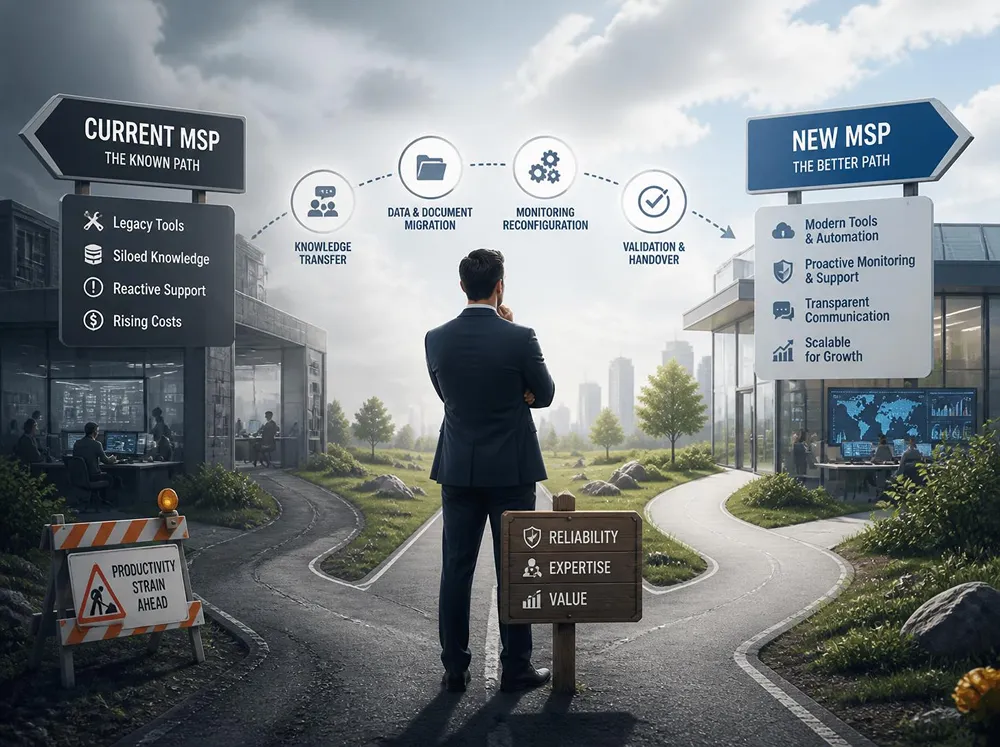
For organizations that are unhappy with their current managed service provider, the instinct is often to switch as quickly as possible. That instinct is understandable. It is also worth tempering with a clear-eyed assessment of what a transition actually involves.
Switching MSPs is more disruptive than most businesses expect. There is the technical migration — documentation that has to be transferred or rebuilt from scratch, monitoring configurations that have to be reestablished, a new provider that has to learn an environment that the previous one understood through years of experience. There is the knowledge gap that exists in the early months of any new relationship before the provider truly understands the business, its priorities, and its quirks. And there is the productivity cost that falls on internal teams who have to support the transition while continuing to do everything else their jobs require.
None of this means staying with an underperforming MSP is the right call. Sometimes the switch is absolutely necessary and the disruption is worth it. But it does mean the decision deserves more analysis than a comparison of monthly fees.
The better approach is to do the work upfront — to ask hard questions before signing rather than discovering the gaps after the contract is in place. Which brings up a question that almost nobody thinks to ask.
The Onboarding Question Nobody Asks

When businesses evaluate managed service providers, they spend significant time on pricing, response time commitments, and service scope. Almost nobody asks the question that may matter most in the first six months of the relationship.
What does onboarding actually look like?
The transition to a new MSP is one of the most operationally vulnerable periods a business can go through. Done well, the process is structured, thorough, and largely invisible to the business. Done poorly, it is months of reactive firefighting as gaps surface one by one, each one revealing something the new provider did not know about the environment they inherited.
The questions worth asking before signing are specific ones. What is your onboarding process, step by step? How long does it typically take to reach a stable operating state? What do you need from us to do it well, and what does the first ninety days look like from our side?
A provider that can answer these questions clearly and specifically has built a process around onboarding through experience. A provider that gives vague or general answers probably has not. That difference becomes very apparent in month two.
What the Best IT Relationships Have in Common
After working with organizations across industries and sizes, a few patterns show up consistently in the businesses that get the most from their technology partnerships.
They treat IT as a business conversation. The leaders who get the best outcomes from their MSP relationships are not the ones who understand every technical detail. They are the ones who communicate clearly about business goals and hold their IT partners accountable for supporting them. Technology decisions get made in the context of where the business is going — not in isolation.
They plan ahead. The businesses that struggle most are making decisions reactively — upgrading systems because they failed, addressing security because they were breached, bringing in support because something broke. The ones that thrive plan technology decisions six to eighteen months out, with their MSP helping shape the roadmap.
They invest in the relationship. The quality of an MSP partnership is directly related to the quality of communication between both sides. Organizations that treat their managed service provider as a vendor to manage tend to get vendor-level service. The ones that treat it as a genuine strategic partnership tend to get something significantly more valuable.
They ask for accountability. The best partnerships are built on clear expectations, defined metrics, and regular reviews where performance is honestly assessed on both sides. Not just from the MSP — from the client as well.
None of this requires technical expertise. It requires the same discipline that runs any other part of a well-managed business.
What to Look for Before You Sign
Choosing a managed service provider — or evaluating the one you have — comes down to a handful of things that are more important than the feature list in the proposal.
Does the provider have a structured onboarding process they can describe specifically? Do they provide regular, meaningful reporting that gives you visibility into your environment — not just incident summaries? Are they proactively bringing you information and recommendations, or do they only show up when there is a problem? Can they describe what a major incident response looks like from experience, not just from a policy document? And do their incentives — the way their business model is structured — actually align with your operational outcomes?
The answers to these questions tell you more about the quality of the relationship you will have than anything in the service agreement.
The Partnership Worth Having
The best managed IT relationships are ones where the business can focus on what it does — serving clients, building products, pursuing growth — with confidence that the technology infrastructure underpinning all of it is being managed by people who understand the business and are actively working to keep it running, secure, and positioned for what comes next.
That kind of partnership does not happen by accident. It is built deliberately, on both sides, with clear expectations and consistent follow-through.
Ocean Solutions works with organizations that are ready to build that kind of relationship. If your current IT partnership is not delivering at that level, we are ready to have an honest conversation about what a better one could look like.
Reach out to the Ocean Solutions team to get started.